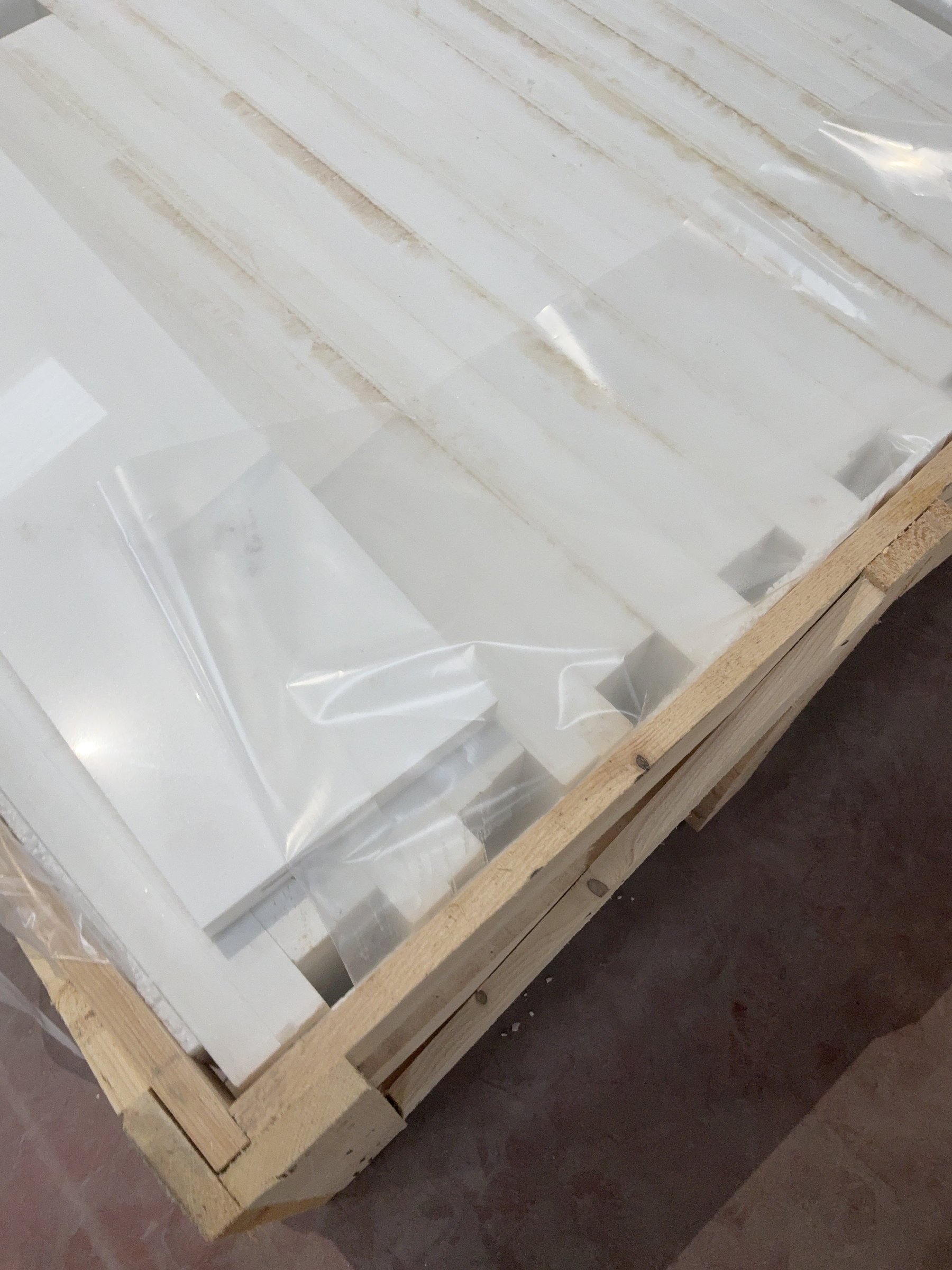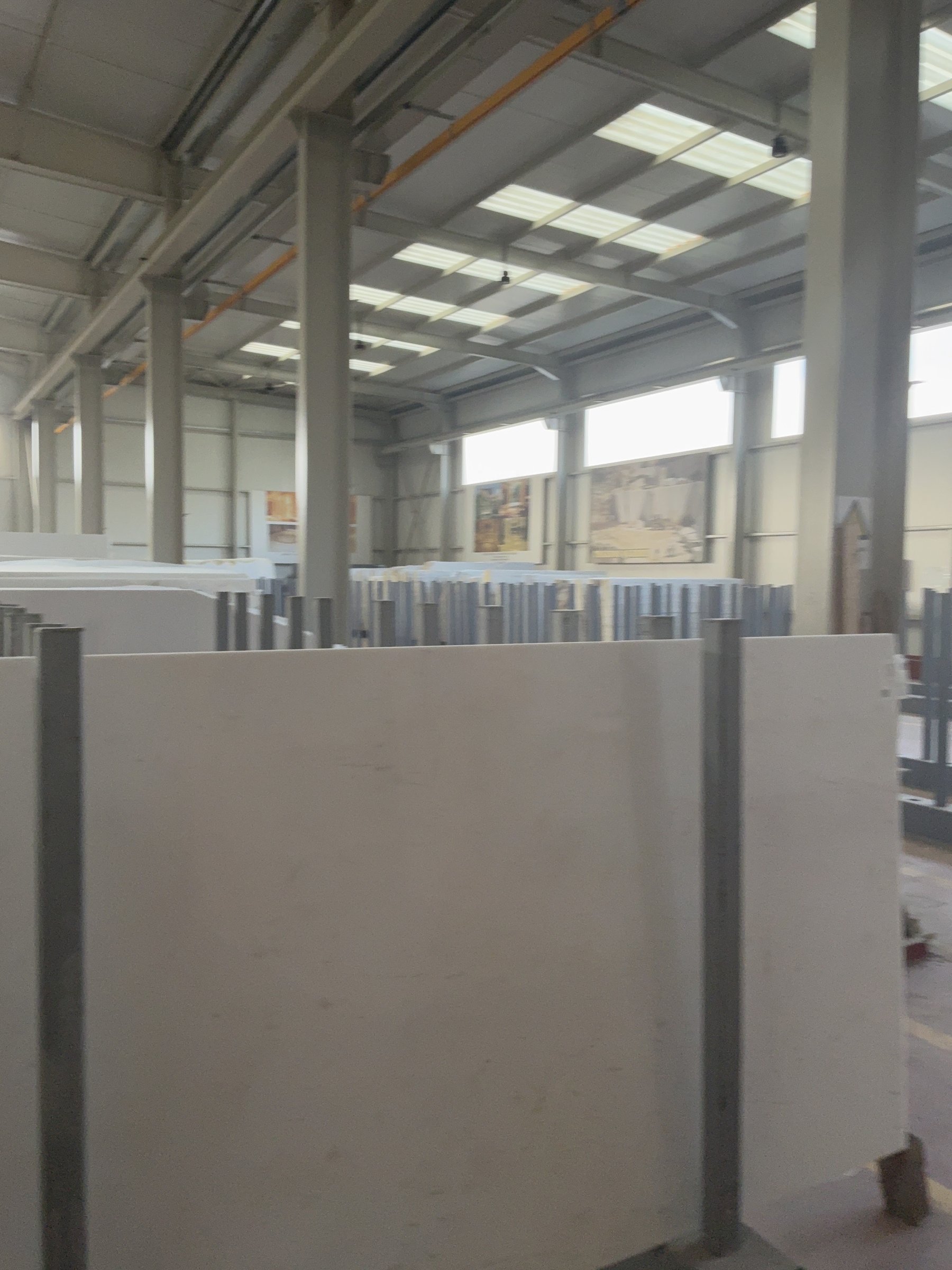
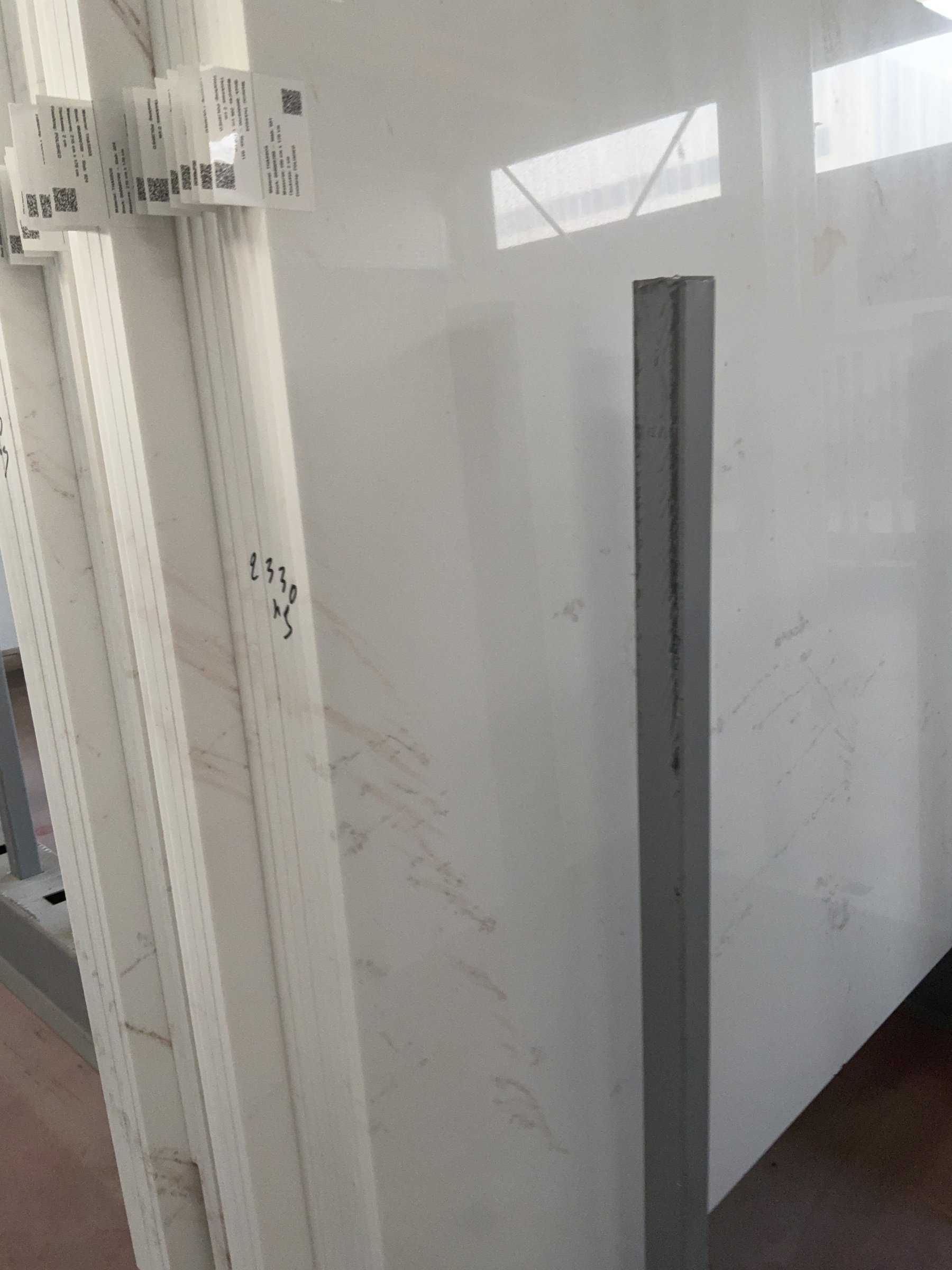
The marble vs porcelain cladding question comes up on almost every residential and commercial project we discuss. Porcelain has improved hugely, and large-format slabs can imitate marble convincingly at a glance. Natural marble, though, offers depth, variation and longevity that a printed surface cannot fully copy. The right answer depends on where the wall is, how it will be used and how long you want it to last.
How each material is made
Marble is a metamorphic rock formed over very long periods under heat and pressure. It is quarried in blocks, sawn into slabs and finished. Its colour and veining run through the full thickness of the stone.
Porcelain is a manufactured ceramic made from refined clays and minerals, pressed and fired at high temperature. The marble look on most porcelain is a digitally printed image on the surface, although some through-body products carry colour deeper.
Appearance and character
Marble has natural translucency: light enters the surface slightly and reflects from the crystals beneath, which gives white marbles in particular a soft glow. Veining is irregular and continuous, so slabs can be book-matched to create mirrored patterns across a wall.
Porcelain gives very consistent results. That is helpful when you need a uniform look over a large area, but the printed pattern repeats after a number of faces, and the edges and any chips reveal a body that may not match the surface.
Durability, weight and fixing
| Factor | Natural marble | Porcelain slabs |
|---|---|---|
| Water absorption | Low to moderate; usually sealed | Very low |
| Acid resistance | Can etch | Generally resistant |
| Weight | Heavier, especially at greater thickness | Lighter in thin formats |
| Repairability | Can be honed, polished and patched | Chips are hard to repair invisibly |
| Lifespan | Can last for centuries with care | Long-lasting, but surface image cannot be renewed |
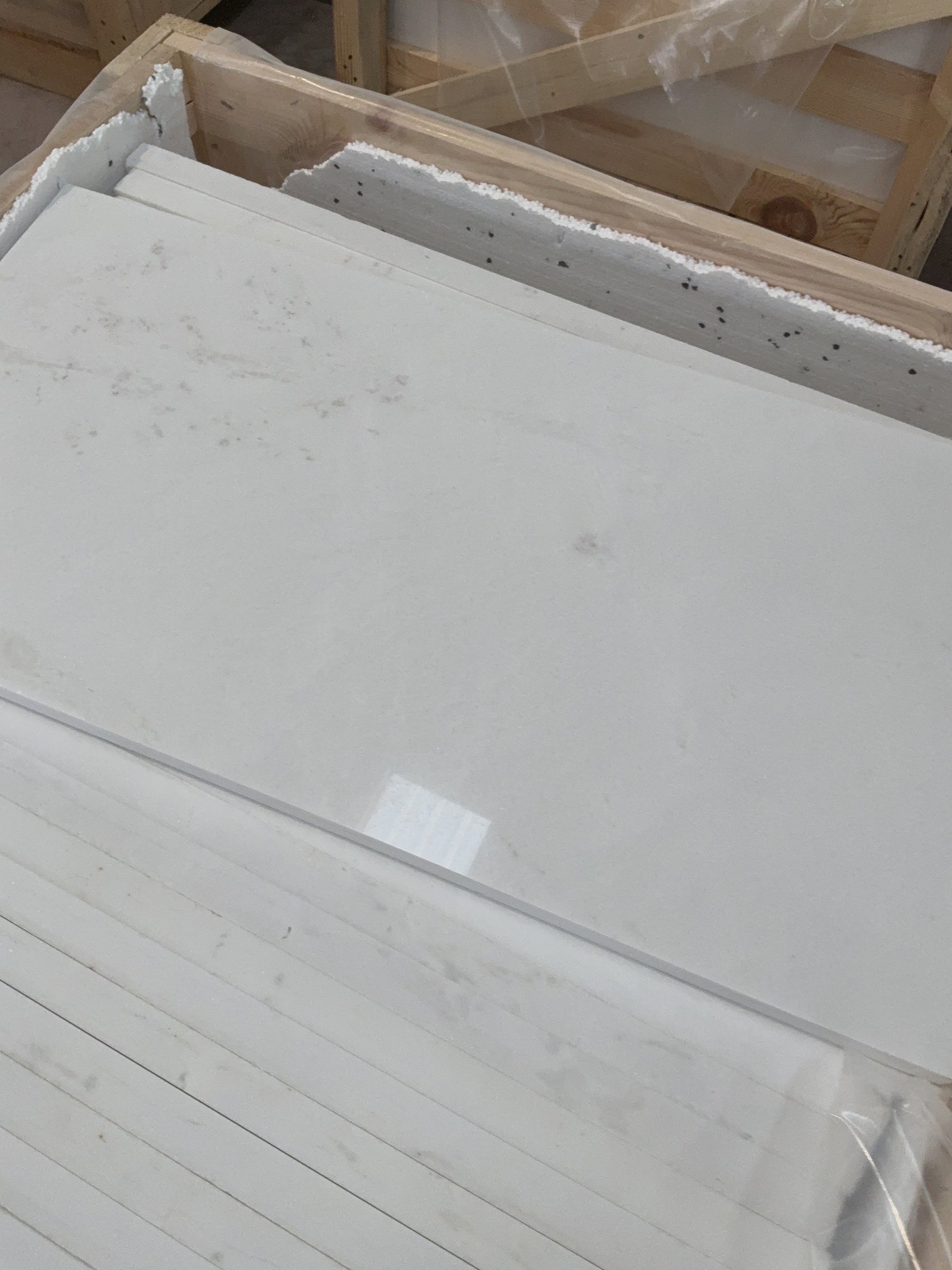
Marble’s weight means it needs a properly designed fixing system on facades, often mechanical anchors on a substructure for exterior work. Thin porcelain is lighter but brittle in large sizes and needs careful handling and suitable adhesives or support systems. In both cases, an engineer should approve exterior cladding details.
Maintenance and ageing
On walls, marble faces far less wear than on floors, so maintenance is modest: periodic cleaning with a pH-neutral cleaner and occasional resealing. Over decades, marble can be cleaned and re-polished to look close to new. Porcelain needs very little care, but if its surface is damaged the only real fix is replacement, and matching a discontinued design years later can be difficult.
Choosing marble vs porcelain cladding for your project
- Choose marble for landmark facades, lobbies, feature walls and any space where authenticity, book-matching and long life matter. Greek whites such as Thassos and Volakas are popular choices.
- Choose porcelain for high-splash areas, budget-sensitive repetitive spaces, or where weight limits are strict.
- Combine them where sensible: marble for the statement walls people see first, porcelain in service areas.
Whichever you choose, accurate cutting matters. Our cut-to-size marble service helps reduce site waste and keeps joints consistent.
Questions to ask before you decide
- How long should the cladding last before a refurbishment is likely?
- Will the wall be touched, leaned on or exposed to knocks from trolleys and furniture?
- Is the wall inside, sheltered, or fully exposed to sun, rain and dust?
- Can the structure carry the weight of stone, or are lighter panels needed?
- Will spare material be available if a panel is damaged in ten years?
Honest answers to these questions usually point clearly towards one material. On many Pakistani projects, the summer heat, seasonal rain and dust all play a part, so the fixing method and joint design deserve as much attention as the face material itself. A well-detailed marble facade with sound anchors and open or sealed joints, designed for movement, will outperform a poorly fixed panel of any kind.
Share your drawings and we can help you weigh up stone choices and quantities. See our marble slabs or contact us.
Frequently asked questions
Is porcelain stronger than marble?
Porcelain is harder and less absorbent, but thin slabs can be brittle. Marble is softer yet tough in thicker formats and can be repaired.
Can marble be used on exterior walls in Pakistan?
Yes, many marbles perform well outside when the right stone, thickness and mechanical fixing system are chosen and approved by an engineer.
Does porcelain look like real marble?
From a distance, good porcelain can look similar. Up close, repeating patterns, edges and the lack of depth usually give it away.
Key topics: marble vs porcelain cladding · wall cladding · natural stone · porcelain slabs · facade design · feature walls